On Soliciting Anonymous Feedback

Everyone knows that you can’t be an effective leader if you’re not willing to listen to the people you lead. But there are so many ways of doing that, some more useful and constructive than others — and some more useful and constructive in some situations and contexts than in others. This post, unfortunately, is not one in which I’m going to offer clear advice based on my experience — instead, I’m going to raise complicated and as-yet unresolved questions based on my experience. Hopefully these questions will be helpful to others wrestling with the challenge of soliciting feedback.

When I came to my current position leading the library at Brigham Young University, I inherited from my predecessors a program we call the Pulse Survey, which is sent once a month to all non-student library employees. The survey consists of three parts:

  1. A single question to which employees are invited to submit a free-text answer. Past questions have included “What could we do to better include all voices in decision-making, especially those from underrepresented roles or perspectives?” and “What motivates you to do your best work each day at the library?”.
  2. A “Kudos” section, which gives employees the opportunity to praise someone else in the organization.
  3. A “Suggestion Box” section, which gives employees the chance to suggest changes or improvements to library policy or practice.

Historically, all responses to the Pulse Survey have been anonymous, and all responses have been shared with all library employees. (The only exception being when an employee submits a response that is in some way patently inappropriate, such as a direct personal attack on another employee or a response that reveals confidential information. Such responses are redacted from the publicly-distributed version of the survey results.)

As one might imagine, the anonymous nature of this survey is a mixed blessing.

On the one hand, there is tremendous value in providing a forum for people to speak their minds freely without fear of retribution. The leadership team has gained valuable insights into the thinking and concerns of our staff by offering that freedom — insights that we certainly never could have gotten from in-person conversations or meeting discussions.

Anonymous public feedback is always a mixed blessing.

On the other hand, there is significant risk in providing a forum for people to speak their minds freely without accountability. At times the Pulse Survey has, unfortunately, served as a platform for axe-grinding and for intemperate and sometimes uninformed criticism of colleagues, policies, and practices — comments that also would almost certainly never have been made if the commenters were not anonymous.

Of course, there are other limitations inherent in gathering information by means of a voluntary and anonymous survey. Response rates tend to hover around 20%, which means that even when a clear majority of respondents express a particular view, we can’t be certain that the expressed view is representative of the library staff’s feelings generally — it may only be representative of those most motivated to respond.

Over the past year, we had noticed an uptick in negative (and, particularly, in unconstructively negative) Pulse responses, and while we recognize the value and importance of such responses (even when they’re not very constructive), we also began to suspect that the Pulse format was starting to create more negativity than utility, and started talking about what we might do to reconfigure it so that it would encourage less axe-grinding and more useful feedback, while still preserving a forum for critical or negative input.

One change with which we are currently experimenting is an alteration in our anonymity policy: now, instead of all Pulse responses being shared publicly with all in the library, we tell survey respondents that while all responses will be reviewed by the library’s leadership team, only signed responses to the survey question and the Suggestion Box section will be shared publicly. (Kudos, signed or not, will still be shared with everyone.) Our hope is that this compromise will strike a good balance between making sure that people can still offer critical responses to the library administration, and not providing a public forum for unconstructive spleen-venting.

Will this prove to be the right balance? We don’t know. At this point we’re in trying-stuff-out mode. I’d be interested to hear from readers who have other ideas, or who approach this issue in a different way in their institutions.

Posted in Uncategorized | 1 Comment

On Reading Dilbert, and on Telling People Not to

A couple of weeks ago I made a note to myself to write a post on this topic, and then the other day I heard that Scott Adams, the creator of the comic strip Dilbert, had just died. So I guess now is the time.

Most of us have probably read Dilbert at some point during our careers. It was a comic strip that ran for decades, dealing with the absurdities of corporate life, and that tended to take particularly sharp aim at failures of management and leadership. The humor — and the strip was regularly very, very funny — often hinged on the cluelessness, venality, egocentrism, and ignorance of people charged with supervising the work of others and furthering the strategic goals of organizations. (Strategic goals themselves — or the lack thereof, or the incoherence thereof, or the manifest idiocy thereof — were also a frequent target.)

Almost 30 years ago, I was in a conference session at which a library director gave a talk during which she expressed her frustration with Dilbert and what she believed was its tendency to foment and nurture cynicism among the workforce. What I found interesting was that the solution she proposed to her audience was not to avoid the kinds of management approaches that were regularly lampooned in Dilbert — instead, what she proposed was that we try to get our employees to stop reading Dilbert.*

The irony of this stance should be immediately obvious; it’s exactly the kind of solution that a clueless manager in Dilbert might have suggested. But it’s also a helpful negative illustration of an important principle of management and leadership. That principle is: you can’t outlaw cynicism; you can only undermine it by genuinely earning your people’s trust. In fact, if you try to outlaw cynicism, all you’ll do is increase it.

You can’t outlaw cynicism in your workplace; you can only undermine it by genuinely earning trust.

Imagine if you were one of the speaker’s library employees in that meeting, and heard your library director say “People need to stop reading Dilbert; it just makes them cynical about the workplace.” What thoughts would be going through your head? If that were me, I would probably be thinking things like:

  • “If she thinks we’re going to identify with Dilbert, then doesn’t that suggest there are things that need to change in our library?”
  • “Does she really think that avoiding Dilbert will make us less cynical about our workplace?”
  • “Can she hear herself? She’s a library director who is literally trying to tell us what not to read.”

But the real lesson for us as leaders isn’t really “don’t tell your staff not to read Dilbert.” In this regard I think this particular library director was an outlier and — let’s be charitable — was speaking off the cuff and may very well have just been having a bad day. The real lesson is that if we find ourselves struggling with an environment of cynicism and mistrust in the units or organizations we lead, the first place to look is not at the failings in our employees’ reading habits, but at the workplace culture for which we have responsibility. If you’re sensing disaffection or grumpiness in the people you lead, start asking around: is that a general vibe, or are you just noticing a few people who are exceptionally unhappy for some reason? Talk to supervisors: how do they read the mood in their particular areas? If you are getting the impression that discontent is generally distributed throughout the library rather than concentrated in a particular trouble spot, consider soliciting anonymous feedback and reviewing it with your leadership and management teams.

Of course, soliciting anonymous feedback is complicated itself, and comes with both pros and cons. We’ll discuss these in my next post.

* Note: I’m aware of Scott Adams’ racially problematic views and his practice of airing them publicly. To be clear, the experience I’ve related here took place many years before those views came to light; this library director’s unhappiness with Dilbert clearly arose from the content of the comic strip itself — it was not a call to boycott Dilbert because of Adams’ views on race.

Posted in Uncategorized | Leave a comment

Can, Should, and Will, Part 2: Science and Religion in the Library

Let me start out by acknowledging that “Science and Religion in the Library” is a provocative subtitle, and to some degree it’s meant to be. Let me explain what I mean by it.

For my purposes here, I’m going to define as “science” those aspects of library work that deal with figuring out and describing things as they are, and as “religion” those that deal with figuring out how things should be and why they should be that way. In the sense that I’m using the terms here, science is descriptive, and religion is prescriptive; science is involved with “is” questions, while religion is involved with “should” questions.

Both are important: on the “science” side, we need to know whether and to what extent our resources are being used by patrons, how much money is left in the budget, and where current trends will take us if they continue. On the “religion” side, we need to be clear on the ultimate goals behind what we do and on the values that inform our policies and practices. Furthermore, unless there’s considerable agreement among library leaders and staff as to those foundational values, we are liable to find ourselves working at cross purposes with one another.

In my previous post, I proposed a Venn diagram that illustrates three spheres of endeavor in the library, two of which represent the things we should do (which is a “should,” or religious question) and those we can do (which is an “is,” or science question). In that post I focused on the imperfect overlap among the three spheres and on why I think it’s important that we understand the dynamics behind their interactions. In this column I want to focus on the essential differences between is and should and on what I think those differences imply for the way we think about and carry out our work in libraries.

In the library, we are constantly faced with “science” questions. For example: 

  • “How often do our patrons use Chemical Abstracts?”
  • “At what point in the future will we have to start canceling individual journal subscriptions in order to continue paying for our comprehensive Elsevier journal package?”
  • “What has been the ten-year trend line for book circulation in our library?”
  • “Is the information in this catalog record accurate?”

I characterize these as “science” questions because they deal with data that can be detected, analyzed, and measured and from which inferences and projections can be made. Different people may disagree about the answers, but, at least in principle, the disagreements can generally be settled by an appeal to objective facts and data. The answers to these questions will tell us what is, but they will not, in and of themselves, tell us what we should do.

In order to proceed from seeing what is to deciding what ought to be, we will have to bring a very different set of questions into play. These might include the following (notice the should terms in italics): 

  • “Are our patrons using Chemical Abstracts at a level that justifies the expense?”
  • “Which individual journal subscriptions should we cancel before we start seriously considering unbundling the Big Deal?”
  • “Given the circulation trend line, would it be wise to redistribute our materials budget?”
  • “Do we have the right amounts of the right information in our catalog records?”

Each of the above is a should question rather than an is question. I categorize them as religious—not because they have to do with the supernatural but because we won’t be able to answer them by simply appealing to facts; in order to answer them, we will have to appeal to values.

And this is where things can get dicey in the library. When two people disagree about whether Chemical Abstracts got 100 uses or 1,000 uses in the previous month, the dispute can be settled by an appeal to data—but when they disagree about whether the usage is sufficient to justify renewal, a different dimension of decision-making comes into play. “Sufficiency to justify” is not an is criterion but a should criterion and can only be answered by reference to values.

Most of us understand this more or less intuitively. If a colleague says, “I reject your circulation data because they say that our patrons decreasingly value the book collection,” most of us will recognize that this stance represents an inappropriate conflation of is and should (“I reject your data because I don’t like what they show”). But we aren’t always as strictly clear about this important distinction in our meetings and policy discussions as we should be. Too often, we do conflate is and should considerations in ways that make it harder to solve problems and serve our patrons. It’s understandable, of course. Consider how similar they can be, at least on the surface: 

  • Is: “We can’t afford to give our patrons everything they want.”
  • Should: “It’s not our job to give patrons everything they want.”
  • Is: “We have to cut another journal if we’re going to subscribe to Journal Y.”
  • Should: “Journal Y is too expensive and its publisher makes too much money.”
  • Is: “We are regularly losing staff members who leave for higher-paying jobs.”
  • Should: “We don’t pay our staff enough.”

Sometimes it’s even harder to tell the difference between should and is statements because one is couched in the terminology of the other—the phrase “we can’t do that” might mean “we don’t have sufficient resources to do that,” or it might mean “doing that would constitute a breach of our values and mission.” The same is true of statements like “we can’t afford Journal X” (which usually means “subscribing to Journal X would require us to cancel something more important”) and “we can’t hire so-and-so” (which may mean either “he doesn’t meet the posted minimum requirements” or “I think he’s an unacceptable candidate”).

Again, it’s important to emphasize that “science” questions are not better or more important than “religion” questions, nor vice versa. Both are essential. But if we’re going to manage our resources and serve our patrons well, then recognizing and dealing with the differences between those kinds of questions is essential.

What does recognizing and dealing with them mean? In practice, for the most part it means simply paying attention and guiding discussion (especially in meetings) accordingly. If you’re running a meeting and encounter religious statements masquerading as science, it might be a good idea gently to unmask them: “John, you mentioned that we can’t afford Journal X—it looks to me like we could afford it if we canceled these three titles from our annual review list. Is it possible that would be a good trade-off?”

Do make sure you unmask them gently, though. No one likes having their religion challenged, no matter what it is.

Posted in Uncategorized | Leave a comment

Can, Should, and Will, Part 1: The Venn Diagram

(N.B. — My two posts this week were originally published as columns in Library Journal‘s “Peer to Peer Review” section back in 2013. Thanks very much to LJ for giving permission to republish them here.)

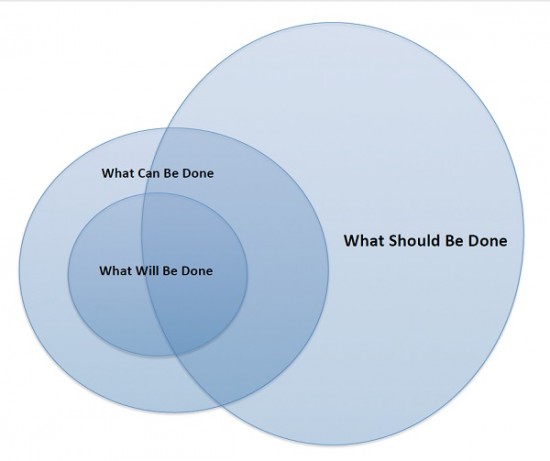
I came up with the diagram below while I was thinking about library management during a recent lull in traffic at the reference desk. My original intent was sort of wryly humorous (it is hilarious, don’t you think?), but the more time I spend looking at it, the more I think it’s a potentially valuable tool for helping give shape to conversations about priority-setting and decision-making in libraries and maybe in other organizations as well. 

Can Should Will Venn Diagram

Let’s tease out a few of its implications. First of all, some assumptions underlying the diagram are these: 

  1. We will not do anything that’s impossible (that’s why the “Will” circle is entirely contained by the “Can” circle).
  2. There are things that we arguably should do that are not possible (which is why the “Can” circle is not entirely contained in the “Should” circle; more about this below).
  3. Of the things we do, some will inevitably be the wrong things (as represented by the portion of the “Will” circle that falls outside the “Should” circle).

Now, it may seem strange that the circle defining what “should” be done is so big and that it overlaps only partially with the one defining what “can” be done. Does it really make sense to say there are things that should be done but can’t? Yes, I think it does—and anyone who has spent time in library meetings will probably understand why.

Sometimes we find ourselves spending meeting time on discussions of things it would be nice to do but which are impossible. These discussions are usually prompted by someone who says something beginning with the words, “If only we could….” The temptation to start down this topical road is intense, because talking about “if only” can offer so much bittersweet pleasure. “If only we had another $500,000 in our materials budget”; “If only we could hire one more full-time staff person to work on the institutional repository”; “If only the faculty cared more about open access”; etc. But since there’s a functionally unlimited number of things we arguably “should” do, and since we can actually do a relatively small number of those things, the “Should” circle is larger than the “Can” circle and the two overlap only partially.

Now to be clear, I’m not saying that we should simply sit back and be content with our current options and capabilities; on the contrary, we need to be constantly working to enlarge the borders of the “Can” circle. Doing so is often possible if we’re intrepid and resourceful and if we give our staff room and permission to try things out, innovate, and make mistakes. So talking in terms of “if only” is not necessarily a waste of time; it can lead us in fruitful directions. But it’s also important not to pretend that the circle of “Can” is infinitely expandable. It isn’t, it never will be, and we need to make sure we deal with that fact in a hardheaded and pragmatic way, even as we seek to push its boundaries.

This reality is to some degree concrete and to some degree determined by mission. All budgets are limited, for example (that’s why they’re called “budgets”). But on a deeper level, it is also an inevitable reality of librarianship that we are always spending someone else’s money in support, ultimately, of someone else’s mission, and that imposes certain obligations of responsibility and pragmatism on us. Talking in blue-sky terms can be useful and rewarding, but it can also be a waste of time. Maintaining the proper balance between responsibility and vision is one of the toughest jobs of a library leader.

The imperfect overlap of the “Will” and “Should” circles is where library leaders need to focus most of their attention and concern. The part of the “Will” circle that falls outside of the “Should” circle represents all those things that we do in the library even though we shouldn’t. Clearly, our goal when making decisions and taking action should be to move the “Will” circle as fully into the “Should” circle as possible, though I think it’s extremely unlikely (bordering on impossible) for any organization to make them overlap perfectly. No matter how hard we try, we will almost certainly end up doing some things we shouldn’t. When that happens accidentally and despite our best efforts, it’s a problem; when we (or members of our organization) do it more or less intentionally—either out of philosophical opposition or willful negligence—it’s a much bigger problem. In any case, the verb tense here is significant: certain things will always get done; inevitably, some subset of those things will be the right thing. We want that subset to be as large as possible.

And, of course, the “will” circle itself is going to be bigger at some libraries, and at certain times, and smaller at others; sometimes we get more done and sometimes less. But it’s inevitable that it will never fall entirely inside of the “should” circle.

Those readers who are paying close attention may be experiencing a nagging sensation in the back of the brain. That nagging sensation is saying, “This whole conversation assumes a coherent understanding of what separates that which is from that which should be.” That is indeed a big assumption, and I plan to discuss it in more depth next time—so stay tuned for “Can, Should, and Will, Part 2: Science and Religion in the Library.”

Posted in Uncategorized | 3 Comments

Seeking Out the Lost Sheep

I’m a member of The Church of Jesus Christ of Latter-day Saints, and I work at Brigham Young University (BYU), the flagship university of the Church’s system of higher education. For the first 32 years of my career as a professional librarian, I worked in places (a bookseller and then three different state universities) where religion was not part of the culture. BYU is very different; as a higher-ed institution it has an explicitly and unapologetically religious mission, and that means that our beliefs and the principles taught by our church are deeply integrated into the work that we do here every day. Our goal is not just to help students become more educated, but also to help them become better and more deeply dedicated Christian disciples and keepers of covenants with God. In fact, that’s our primary mission; higher education is the means whereby we carry it out.

What this means, among other things, is that it’s quite common in my library for us to talk about the work we do in explicitly religious terms, and this can be particularly the case when we’re dealing with personnel issues.

I’m going to go out on a limb a bit here, and offer to what I assume is a predominantly secular readership a lesson in personnel management based on a parable of Jesus. It’s one that many might recognize, drawn from the book of Matthew, chapter 18, verses 11-14 (here I’m using the King James Version of the Bible):

For the Son of man [i.e., Jesus] is come to save that which was lost.

How think ye? If a man have an hundred sheep, and one of them be gone astray, doth he not leave the ninety and nine, and goeth into the mountains, and seeketh that which is gone astray?

And if it so be that he find it, verily I say unto you, he rejoicenth more of that sheep, than of the ninety and nine which went not astray.

Even so it is not the will of your Father which is in heaven, that one of these little ones should perish.

Without getting drawn into the practical implications of leaving the “ninety and nine” behind in order to go in search of one lost sheep — this is a passage of scripture that generates a lot of discussion along those lines — what I want to focus on here is the leader’s orientation towards a “lost sheep.”

What might a “lost sheep” look like in the context of an academic library? It might be someone who:

  • … is struggling to meet the requirements of tenure.
  • … has tried to get tenure, and failed, and is now on a terminal contract.
  • … has gotten crosswise with university administration and is now in their crosshairs.
  • … has offended a student (or a large group of students) and is now being targeted on social media.
  • … drives everyone in the library crazy and has no friends.
  • … has cancer and a grim prognosis.
  • … has just lost a child or spouse.

If you’re a manager or an administrator, it can be very tempting to steer clear of employees in these (and similar) situations. If they’re in trouble with the university, you might not want to be seen as their ally; if they’re on a terminal contract, you might avoid them because you don’t know what to say; if they’re obnoxious, you might steer clear of them because they’re, you know, obnoxious.

All of these are 100% understandable postures for a leader to take. They’re also the opposite of what you should be doing. Part of doing a leader’s work is pushing past the very understandable impulse to let that “lost sheep” wander off into the wilderness (where it will conveniently leave you alone to get your work done), and instead embrace the imperative of finding that lost sheep and, if possible, bringing him or her back to the fold.

Of course, bringing him or her back to the fold won’t always be possible, because library employees are agents who make choices, and also because sometimes they’re lost due circumstances beyond both their control and yours. That librarian with the terminal contract will be gone at the end of the contract regardless of whether you reach out to him; the obnoxious employee will probably not magically gain a new personality and the love of her colleagues just because you’re kind to her. You can’t cure your employee’s cancer.

But being an effective leader is not only a matter of bringing about desired organizational and HR goals. It’s also a matter of showing genuine love and care for your people, and creating an environment in which that love and care are pervasive. Doing that successfully won’t mean that everyone is always happy; it certainly won’t (and can’t) mean that everyone will always get what they want. But it will mean that your people will know that you care about them, even when you’re saying “no,” and even when you’re enacting policies they don’t like, and even when you’re holding them accountable.

Does that sound idealistic and sappy and naïve? Maybe it does. That’s okay. I’m convinced it’s a true principle anyway.

Now, I want to make one thing very, very clear: I offer this particular post very much in the spirit of “do as I say, not as I do.” I want to be very up-front about the fact that I am not good at the principle I’m promoting here. Not only am I a shy and introverted person by nature for whom normal social interaction is tiring, I’m also just as averse as anyone else to potentially awkward and difficult interactions with the people I’ve been hired to lead. I don’t necessarily know what to say to the person on a terminal contract, or with a terminal diagnosis. I don’t want to extend myself to the people in my organization who drive me (and sometimes everyone else) crazy — I count it a good day if I go home without seeing those people.

I’m also an unusually impatient person, and decades of leadership experience have done little to change that, or to make me more likely to extend myself to those who are struggling when I know that doing so will be difficult.

But I know that I need to do better. I’ve learned this from both the good and the bad leaders with whom I’ve been privileged to work over the years — I’ve seen how powerful it can be when a leader extends a hand to someone in the organization who is struggling, even if it’s just a hand of empathy and kindness, and I’ve also seen how powerfully negative it can be when a leader writes someone off and treats her as unworthy of the leader’s time and attention.

So by writing this today I’m publicly calling myself to account to do better in this regard. I owe it to my organization, and I also believe that, as a covenant disciple of Christ, I owe it to my Savior. But you don’t have to believe as I do, or believe in anything at all, to try this principle out and see it work.

Posted in Uncategorized | 2 Comments

Reflecting on the first year and the future of V&B

Hi, all —

Well, it’s been a fun and interesting 14 months or so since I started Vision & Balance in October 2024.

I started writing V&B with the idea that it could provide the service of letting other library managers and leaders — especially newcomers to leadership — learn lessons the easy way that I’ve learned the hard way. My plan was to write twice per week.

At the beginning, I had two main concerns:

First, how soon was I going to run out of topics worth writing about? As a hedge against this concern, before starting the newsletter I compiled a several-pages-long list of topics that seemed worth addressing. Counting them up, I found that I had almost a whole year’s worth of subjects — enough to convince me that it was worth giving the experiment a shot. And as time went on, I found that writing these posts tended to generate more ideas, so that even as I crossed topics off the original list I was adding new ones almost as quickly; my current list of potential post topics is nearly as long as the one I started with over a year ago.

Second, was anyone going to feel any need to read what I wrote? This was by far the bigger risk, and the question that has remained somewhat unresolved. When I started V&B as a subscription newsletter — with one of the two weekly posts offered freely to all and the other restricted to paying subscribers — I found (unsurprisingly enough) that a fair number of people were interested enough to sign up and that relatively few were willing to pay. But at least there was some interest! I ended up making just enough money to cover my up-front costs in publishing the newsletter on the Ghost platform. Frustrations with that platform, however, eventually led me to reconfigure the newsletter as a blog, at which point I also decided to just make the whole thing free to everyone. I don’t really need the money — or, at least, I don’t need the very small amount of money subscriptions were generating.

In recent months, though, I’ve started wondering whether the number of people reading justifies the amount of time and effort I spend writing. I’m keenly aware that I’ve done next to nothing to market this thing, and that’s probably one reason for the relatively low readership (which ranges from the single digits for some posts to the several hundreds for a handful of others). Another reason may simply be that the insights and ideas I’m sharing aren’t especially interesting, useful, or insightful. Up until a couple of weeks ago I was feeling ready to just let V&B die a natural death and move on with other projects — and then, with very odd timing, a reader reached out to me to say thanks for one of my posts and offered the observation that he had just completed a graduate management program and found that the stuff I was writing in V&B was “right up there” with some of the best things he’d read in his program, and said “please keep going.”

So there goes my easy out. 🙂

Anyway, this has all given me plenty to think about as I head into the Christmas break.

More to come, one way or another, in the new year.

Posted in Uncategorized | 3 Comments

Happy Thanksgiving!

Vision & Balance is on holiday-and-grandbaby break today. Hope you are too. (On break, at least.)

Posted in Uncategorized | Leave a comment

Eight Things Every Library Leader Needs to Do, Part 8: When in Doubt, Shut up and Listen

Let’s close out this eight-part series on Things Library Leaders Need to Do with an obvious one — but one that requires a bit more unpacking than it may typically get.

All of us understand (though not all of us have fully internalized) the vital importance of listening well as a library leader. And obviously, listening well means more than just not talking while the other person talks – it means really listening, with intention, and with the goal of understanding. Ultimately it means asking questions — maybe challenging ones sometimes, but more often questions designed to enhance and deepen your understanding of where the other person is coming from. But those questions shouldn’t come until you’ve shut up and listened.

Here’s the thing, though: we’re talking about three different skills, all of them essential for a leader:

  1. Shutting up
  2. Listening
  3. Shutting up and listening

Let me explain why I say they’re three different skills, and why I think all of them are essential for library leaders.

First of all, you can shut up without listening. Shutting up can mean simply refusing to talk; or exercising all of your self-control to refrain from speaking even though you’re visibly dying to say something; or ignoring the person speaking. Make no mistake, being able to shut up in situations where it’s killing you not to say something can be a vital skill — in fact, it can save your job. But it’s not the same thing as shutting up and listening.

Second of all, you can listen without shutting up. Not simultaneously, of course — you really can’t be listening to someone at the same time you’re talking to them. But you can interject yourself into the other person’s monologue with clarifying questions or comments of your own, questions and comments that may illustrate clearly that you’re listening. Like shutting up without listening, listening without shutting up can be an entirely appropriate and even important approach in some situations. Sometimes asking clarifying questions or offering explicit expressions of support and care is vital for conveying your engagement with the person you’re listening to. But it’s not the same thing as shutting up and listening.

Shutting up and listening is a specific strategy. It implies not talking, but still making clear through body language and non-verbal engagement that you’re being fully attentive and making a good-faith effort to understand. It means exercising patience — not fidgety, “I’m resisting the overwhelming impulse to interrupt” patience, but rather the genuine recognition that you need more information before responding. Note-taking can be involved, though if you’re going to take notes while someone else is talking to you, it’s essential to pay especially close attention to your body language: the vital difference between “I’m writing this down because you’ve made valid and important point” and “I’m writing this down because I want to remember it later so I can beat you over the head with it” is conveyed entirely by facial expression at the moment you start writing.

As leaders in libraries, there are many situations in which a mastery of shutting up and listening is really essential. When an employee comes to you with a grievance about another employee (or, even more crucially, about you or your team), it’s essential not only that you shut up and listen, but that the person you’re hearing from be able to tell that you’re listening. When you hear one person’s report of malfeasance on the part of another, it’s essential not only that you listen to the reporter, but also to the person being reported on — and maybe bystanders and onlookers as well, and that each of them feel the full effect of your listening before you open your mouth (or put fingers to keyboard) to express an opinion on the situation. When someone is expressing concern about a library policy or practice, it’s essential that you make sure you really understand the concern and the context that created it before you try to put the concern to rest.

Of course, the important principle of shutting up and listening can — like any other good and important principle — be taken too far. I once worked in a library in which the faculty expressed a desire for a regular meeting in which they would talk to the leader but the leader would not be allowed to respond; instead, they were simply to shut up and listen. This, in my view, would represent an abuse of the principle, because it seems to me that such a meeting has the sole purpose of letting people yell at the leader. That might be fun for the employees, but it would be neither fair nor productive. Ultimately, the purpose of shutting up and listening is not to create space for monologue; it’s to make dialogue more productive and lead to better outcomes for everyone in the organization.

Posted in Uncategorized | 1 Comment

Eight Things Every Library Leader Needs to Do, Part 7: Give Credit for the Good, Take Credit for the Bad

When you’re a library dean or director, a certain amount of spotlight will naturally be directed towards you. Being gracious and natural in the spotlight is, therefore, an important skill for library leaders, and I’ll go further and say that leaders who duck the spotlight (rather than learning how to function well in it) are not fully doing their job. Sometimes there are things you can accomplish for your people and your institution when you’re in the spotlight that you can’t accomplish otherwise.

That said, one of the most valuable things a library leader can do is to redirect the spotlight, where possible, especially when the spotlight is shining on you because of an accomplishment of some kind. Back in January, I talked about the importance of looking for opportunities to put the people you lead in the spotlight, and today I want to address a variation on that theme: the importance not only of directing attention to your people when good things happen, but also of pulling attention away from them when bad things happen.

Being a library leader means accepting accountability for the things that go wrong within your scope of stewardship. If you’re the director or dean, that means you’re responsible for anything that goes wrong in the library — you may not have caused it to go wrong, and you may not be directly to blame, but the responsibility (including the responsibility to ensure the situation gets resolved) is yours. If you’re a division head or a department chair, the same is true within your division or department.

I think we all understand that. But what does it mean in practice?

It can mean several things. Important ones include:

  • When an angry person comes in gunning for one of your people, put yourself in the way and stop them. Your job is to address the issue with your employee; that is not the job of someone from outside the organization (unless they have a campus job that requires it, such as in central HR).
  • When someone wants to know who was responsible for a disaster, your answer should be along the lines of “Me. I’m responsible, and will work with my people to fix this problem and ensure that something like this doesn’t happen again. If you have further concerns, please bring them to me.”
  • Never throw one of your people under the bus. Even when it’s obvious which of your employees caused a problem, never use that person as cover for yourself. Take responsibility for the organizational failure and then work with that employee behind the scenes in whatever way is needed to get it resolved.

Now, to be clear: none of this means that you should cover up genuine malfeasance (as opposed to simple error) on the part of one of your employees. Everyone in your library is accountable for his or her behavior and needs to be held accountable. But how that accountability is managed matters very much.

So enough about the bad stuff. How about when good things happen?

As a library leader, you will often receive praise from outside the organization. And sometimes you’ll actually deserve it. If it’s true that the library’s failures are your responsibility, it’s also true that you deserve credit for the library’s successes. However, part of being an effective leader is learning to resist the temptation to take all the credit you deserve. One important skill to learn is that of receiving praise graciously and then redirecting it gracefully.

For example: suppose a vice president stops by your office and says “Man, the library is always so filled with busy students. You’ve done a great job of creating student-friendly spaces here.” In response, you could just say “Thanks, yes — I’m really proud of what we’ve done.” Better, though, would be to say “Thanks, yes — we had an amazing committee of three librarians and three staff who worked really hard to design our spaces and they did an amazing job. I was consistently impressed with their creativity and their student-centeredness.”

Or suppose a faculty member thanks you for the library’s recent purchase of a database that will greatly enhance her department’s ability to do its work. You could smile and say “You’re welcome; I’m grateful we can be of support to you.” Or, better, you could say “You know, our head of collection development worked really hard to negotiate that license agreement and make it possible for us to purchase the database. Could I introduce you to her? I’m sure she’d love to hear what a difference it’s making for your department.”

Or suppose a powerful and influential alumnus congratulates you on the library’s recent rise in a national ranking, implying that it was due to your leadership. You could say “Yes, that recognition is very gratifying.” Or, better, you could say “You know what I think contributed significantly to our higher ranking? The workflow changes we put in place that reduced turnaround time for book requests. Our fulfillment team really went above and beyond to improve patrons’ experience with our services, and they just knocked it out of the park.”

Here’s the thing, though. This only works if you mean it — if you really are that proud of your people, and if they really did the work you’re talking about. People can smell false modesty a mile away, and redirecting the spotlight will only be really effective if you genuinely want it to shine on others rather than yourself.

Developing that kind of humility isn’t easy, though, and it takes time for all of us. In the meantime, we can fake it as best we can.

Posted in Uncategorized | Leave a comment

A Brief Diversion from the “Eight Things” Series

As many Vision & Balance readers know, library leadership isn’t my usual beat — most of my writing and speaking is on the topic of scholarly communication. And while I don’t usually use this platform to discuss those issues, I’m making an exception in this case because I have a pair of posts up at the Scholarly Kitchen (one that was published yesterday, the other today) that do have a real bearing on leadership in libraries.

I won’t rehash both of those posts here (links to them are provided below), but I invite V&B readers to consider the issues discussed in them and consider questions like:

  • What is my host institution’s posture with regard to scholarly publishing practices, and particularly open scholarship?
  • How does my library’s posture reflect that of my institution?
  • If there is a disconnect between them, do I need to work with my administration to resolve it?
  • What do the people I lead believe and/or want with regard to scholarly communication policies and practices? Is there a disconnect between what they want and what I believe is wise and appropriate?
  • What scholcomm future do I believe my library should be working to create?

The answers to these questions will have real implications not only for your library itself and the way it uses resources, but also for your library’s centrally important relationship with your host institution and with the people it exists to serve. And it’s important to note that these questions are currently being answered by government agencies, funders, publishing bodies, library organizations, and others — and that if you want to be part of the process of determining those answers, it is well past time to get involved.

Here are links to the pieces:

The Global Transition Has Already Happened — It’s Just Not the One You Expected

In Defense of Pluralism and Diversity: A Modest Manifesto for the Future of Scholarly Communication

Posted in Uncategorized | Leave a comment