
Can, Should, and Will, Part 1: The Venn Diagram

(N.B. — My two posts this week were originally published as columns in Library Journal‘s “Peer to Peer Review” section back in 2013. Thanks very much to LJ for giving permission to republish them here.)

I came up with the diagram below while I was thinking about library management during a recent lull in traffic at the reference desk. My original intent was sort of wryly humorous (it is hilarious, don’t you think?), but the more time I spend looking at it, the more I think it’s a potentially valuable tool for helping give shape to conversations about priority-setting and decision-making in libraries and maybe in other organizations as well. 
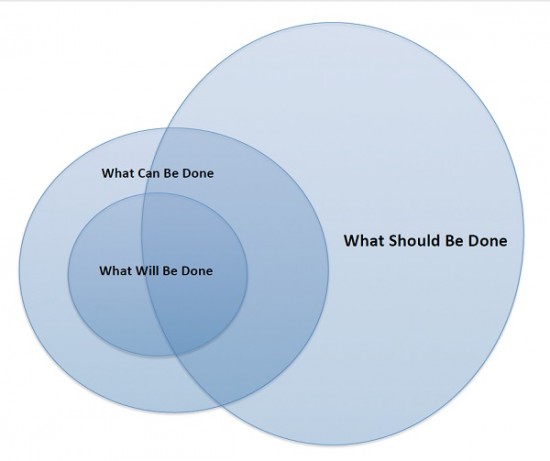
Can Should Will Venn Diagram

Let’s tease out a few of its implications. First of all, some assumptions underlying the diagram are these: 

  1. We will not do anything that’s impossible (that’s why the “Will” circle is entirely contained by the “Can” circle).
  2. There are things that we arguably should do that are not possible (which is why the “Can” circle is not entirely contained in the “Should” circle; more about this below).
  3. Of the things we do, some will inevitably be the wrong things (as represented by the portion of the “Will” circle that falls outside the “Should” circle).

Now, it may seem strange that the circle defining what “should” be done is so big and that it overlaps only partially with the one defining what “can” be done. Does it really make sense to say there are things that should be done but can’t? Yes, I think it does—and anyone who has spent time in library meetings will probably understand why.

Sometimes we find ourselves spending meeting time on discussions of things it would be nice to do but which are impossible. These discussions are usually prompted by someone who says something beginning with the words, “If only we could….” The temptation to start down this topical road is intense, because talking about “if only” can offer so much bittersweet pleasure. “If only we had another $500,000 in our materials budget”; “If only we could hire one more full-time staff person to work on the institutional repository”; “If only the faculty cared more about open access”; etc. But since there’s a functionally unlimited number of things we arguably “should” do, and since we can actually do a relatively small number of those things, the “Should” circle is larger than the “Can” circle and the two overlap only partially.

Now to be clear, I’m not saying that we should simply sit back and be content with our current options and capabilities; on the contrary, we need to be constantly working to enlarge the borders of the “Can” circle. Doing so is often possible if we’re intrepid and resourceful and if we give our staff room and permission to try things out, innovate, and make mistakes. So talking in terms of “if only” is not necessarily a waste of time; it can lead us in fruitful directions. But it’s also important not to pretend that the circle of “Can” is infinitely expandable. It isn’t, it never will be, and we need to make sure we deal with that fact in a hardheaded and pragmatic way, even as we seek to push its boundaries.

This reality is to some degree concrete and to some degree determined by mission. All budgets are limited, for example (that’s why they’re called “budgets”). But on a deeper level, it is also an inevitable reality of librarianship that we are always spending someone else’s money in support, ultimately, of someone else’s mission, and that imposes certain obligations of responsibility and pragmatism on us. Talking in blue-sky terms can be useful and rewarding, but it can also be a waste of time. Maintaining the proper balance between responsibility and vision is one of the toughest jobs of a library leader.

The imperfect overlap of the “Will” and “Should” circles is where library leaders need to focus most of their attention and concern. The part of the “Will” circle that falls outside of the “Should” circle represents all those things that we do in the library even though we shouldn’t. Clearly, our goal when making decisions and taking action should be to move the “Will” circle as fully into the “Should” circle as possible, though I think it’s extremely unlikely (bordering on impossible) for any organization to make them overlap perfectly. No matter how hard we try, we will almost certainly end up doing some things we shouldn’t. When that happens accidentally and despite our best efforts, it’s a problem; when we (or members of our organization) do it more or less intentionally—either out of philosophical opposition or willful negligence—it’s a much bigger problem. In any case, the verb tense here is significant: certain things will always get done; inevitably, some subset of those things will be the right thing. We want that subset to be as large as possible.

And, of course, the “will” circle itself is going to be bigger at some libraries, and at certain times, and smaller at others; sometimes we get more done and sometimes less. But it’s inevitable that it will never fall entirely inside of the “should” circle.

Those readers who are paying close attention may be experiencing a nagging sensation in the back of the brain. That nagging sensation is saying, “This whole conversation assumes a coherent understanding of what separates that which is from that which should be.” That is indeed a big assumption, and I plan to discuss it in more depth next time—so stay tuned for “Can, Should, and Will, Part 2: Science and Religion in the Library.”

Posted in Uncategorized | 3 Comments

Seeking Out the Lost Sheep

I’m a member of The Church of Jesus Christ of Latter-day Saints, and I work at Brigham Young University (BYU), the flagship university of the Church’s system of higher education. For the first 32 years of my career as a professional librarian, I worked in places (a bookseller and then three different state universities) where religion was not part of the culture. BYU is very different; as a higher-ed institution it has an explicitly and unapologetically religious mission, and that means that our beliefs and the principles taught by our church are deeply integrated into the work that we do here every day. Our goal is not just to help students become more educated, but also to help them become better and more deeply dedicated Christian disciples and keepers of covenants with God. In fact, that’s our primary mission; higher education is the means whereby we carry it out.

What this means, among other things, is that it’s quite common in my library for us to talk about the work we do in explicitly religious terms, and this can be particularly the case when we’re dealing with personnel issues.

I’m going to go out on a limb a bit here, and offer to what I assume is a predominantly secular readership a lesson in personnel management based on a parable of Jesus. It’s one that many might recognize, drawn from the book of Matthew, chapter 18, verses 11-14 (here I’m using the King James Version of the Bible):

For the Son of man [i.e., Jesus] is come to save that which was lost.

How think ye? If a man have an hundred sheep, and one of them be gone astray, doth he not leave the ninety and nine, and goeth into the mountains, and seeketh that which is gone astray?

And if it so be that he find it, verily I say unto you, he rejoicenth more of that sheep, than of the ninety and nine which went not astray.

Even so it is not the will of your Father which is in heaven, that one of these little ones should perish.

Without getting drawn into the practical implications of leaving the “ninety and nine” behind in order to go in search of one lost sheep — this is a passage of scripture that generates a lot of discussion along those lines — what I want to focus on here is the leader’s orientation towards a “lost sheep.”

What might a “lost sheep” look like in the context of an academic library? It might be someone who:

  • … is struggling to meet the requirements of tenure.
  • … has tried to get tenure, and failed, and is now on a terminal contract.
  • … has gotten crosswise with university administration and is now in their crosshairs.
  • … has offended a student (or a large group of students) and is now being targeted on social media.
  • … drives everyone in the library crazy and has no friends.
  • … has cancer and a grim prognosis.
  • … has just lost a child or spouse.

If you’re a manager or an administrator, it can be very tempting to steer clear of employees in these (and similar) situations. If they’re in trouble with the university, you might not want to be seen as their ally; if they’re on a terminal contract, you might avoid them because you don’t know what to say; if they’re obnoxious, you might steer clear of them because they’re, you know, obnoxious.

All of these are 100% understandable postures for a leader to take. They’re also the opposite of what you should be doing. Part of doing a leader’s work is pushing past the very understandable impulse to let that “lost sheep” wander off into the wilderness (where it will conveniently leave you alone to get your work done), and instead embrace the imperative of finding that lost sheep and, if possible, bringing him or her back to the fold.

Of course, bringing him or her back to the fold won’t always be possible, because library employees are agents who make choices, and also because sometimes they’re lost due circumstances beyond both their control and yours. That librarian with the terminal contract will be gone at the end of the contract regardless of whether you reach out to him; the obnoxious employee will probably not magically gain a new personality and the love of her colleagues just because you’re kind to her. You can’t cure your employee’s cancer.

But being an effective leader is not only a matter of bringing about desired organizational and HR goals. It’s also a matter of showing genuine love and care for your people, and creating an environment in which that love and care are pervasive. Doing that successfully won’t mean that everyone is always happy; it certainly won’t (and can’t) mean that everyone will always get what they want. But it will mean that your people will know that you care about them, even when you’re saying “no,” and even when you’re enacting policies they don’t like, and even when you’re holding them accountable.

Does that sound idealistic and sappy and naïve? Maybe it does. That’s okay. I’m convinced it’s a true principle anyway.

Now, I want to make one thing very, very clear: I offer this particular post very much in the spirit of “do as I say, not as I do.” I want to be very up-front about the fact that I am not good at the principle I’m promoting here. Not only am I a shy and introverted person by nature for whom normal social interaction is tiring, I’m also just as averse as anyone else to potentially awkward and difficult interactions with the people I’ve been hired to lead. I don’t necessarily know what to say to the person on a terminal contract, or with a terminal diagnosis. I don’t want to extend myself to the people in my organization who drive me (and sometimes everyone else) crazy — I count it a good day if I go home without seeing those people.

I’m also an unusually impatient person, and decades of leadership experience have done little to change that, or to make me more likely to extend myself to those who are struggling when I know that doing so will be difficult.

But I know that I need to do better. I’ve learned this from both the good and the bad leaders with whom I’ve been privileged to work over the years — I’ve seen how powerful it can be when a leader extends a hand to someone in the organization who is struggling, even if it’s just a hand of empathy and kindness, and I’ve also seen how powerfully negative it can be when a leader writes someone off and treats her as unworthy of the leader’s time and attention.

So by writing this today I’m publicly calling myself to account to do better in this regard. I owe it to my organization, and I also believe that, as a covenant disciple of Christ, I owe it to my Savior. But you don’t have to believe as I do, or believe in anything at all, to try this principle out and see it work.

Posted in Uncategorized | 2 Comments

Reflecting on the first year and the future of V&B

Hi, all —

Well, it’s been a fun and interesting 14 months or so since I started Vision & Balance in October 2024.

I started writing V&B with the idea that it could provide the service of letting other library managers and leaders — especially newcomers to leadership — learn lessons the easy way that I’ve learned the hard way. My plan was to write twice per week.

At the beginning, I had two main concerns:

First, how soon was I going to run out of topics worth writing about? As a hedge against this concern, before starting the newsletter I compiled a several-pages-long list of topics that seemed worth addressing. Counting them up, I found that I had almost a whole year’s worth of subjects — enough to convince me that it was worth giving the experiment a shot. And as time went on, I found that writing these posts tended to generate more ideas, so that even as I crossed topics off the original list I was adding new ones almost as quickly; my current list of potential post topics is nearly as long as the one I started with over a year ago.

Second, was anyone going to feel any need to read what I wrote? This was by far the bigger risk, and the question that has remained somewhat unresolved. When I started V&B as a subscription newsletter — with one of the two weekly posts offered freely to all and the other restricted to paying subscribers — I found (unsurprisingly enough) that a fair number of people were interested enough to sign up and that relatively few were willing to pay. But at least there was some interest! I ended up making just enough money to cover my up-front costs in publishing the newsletter on the Ghost platform. Frustrations with that platform, however, eventually led me to reconfigure the newsletter as a blog, at which point I also decided to just make the whole thing free to everyone. I don’t really need the money — or, at least, I don’t need the very small amount of money subscriptions were generating.

In recent months, though, I’ve started wondering whether the number of people reading justifies the amount of time and effort I spend writing. I’m keenly aware that I’ve done next to nothing to market this thing, and that’s probably one reason for the relatively low readership (which ranges from the single digits for some posts to the several hundreds for a handful of others). Another reason may simply be that the insights and ideas I’m sharing aren’t especially interesting, useful, or insightful. Up until a couple of weeks ago I was feeling ready to just let V&B die a natural death and move on with other projects — and then, with very odd timing, a reader reached out to me to say thanks for one of my posts and offered the observation that he had just completed a graduate management program and found that the stuff I was writing in V&B was “right up there” with some of the best things he’d read in his program, and said “please keep going.”

So there goes my easy out. 🙂

Anyway, this has all given me plenty to think about as I head into the Christmas break.

More to come, one way or another, in the new year.

Posted in Uncategorized | 3 Comments

Happy Thanksgiving!

Vision & Balance is on holiday-and-grandbaby break today. Hope you are too. (On break, at least.)

Posted in Uncategorized | Leave a comment

Eight Things Every Library Leader Needs to Do, Part 8: When in Doubt, Shut up and Listen

Let’s close out this eight-part series on Things Library Leaders Need to Do with an obvious one — but one that requires a bit more unpacking than it may typically get.

All of us understand (though not all of us have fully internalized) the vital importance of listening well as a library leader. And obviously, listening well means more than just not talking while the other person talks – it means really listening, with intention, and with the goal of understanding. Ultimately it means asking questions — maybe challenging ones sometimes, but more often questions designed to enhance and deepen your understanding of where the other person is coming from. But those questions shouldn’t come until you’ve shut up and listened.

Here’s the thing, though: we’re talking about three different skills, all of them essential for a leader:

  1. Shutting up
  2. Listening
  3. Shutting up and listening

Let me explain why I say they’re three different skills, and why I think all of them are essential for library leaders.

First of all, you can shut up without listening. Shutting up can mean simply refusing to talk; or exercising all of your self-control to refrain from speaking even though you’re visibly dying to say something; or ignoring the person speaking. Make no mistake, being able to shut up in situations where it’s killing you not to say something can be a vital skill — in fact, it can save your job. But it’s not the same thing as shutting up and listening.

Second of all, you can listen without shutting up. Not simultaneously, of course — you really can’t be listening to someone at the same time you’re talking to them. But you can interject yourself into the other person’s monologue with clarifying questions or comments of your own, questions and comments that may illustrate clearly that you’re listening. Like shutting up without listening, listening without shutting up can be an entirely appropriate and even important approach in some situations. Sometimes asking clarifying questions or offering explicit expressions of support and care is vital for conveying your engagement with the person you’re listening to. But it’s not the same thing as shutting up and listening.

Shutting up and listening is a specific strategy. It implies not talking, but still making clear through body language and non-verbal engagement that you’re being fully attentive and making a good-faith effort to understand. It means exercising patience — not fidgety, “I’m resisting the overwhelming impulse to interrupt” patience, but rather the genuine recognition that you need more information before responding. Note-taking can be involved, though if you’re going to take notes while someone else is talking to you, it’s essential to pay especially close attention to your body language: the vital difference between “I’m writing this down because you’ve made valid and important point” and “I’m writing this down because I want to remember it later so I can beat you over the head with it” is conveyed entirely by facial expression at the moment you start writing.

As leaders in libraries, there are many situations in which a mastery of shutting up and listening is really essential. When an employee comes to you with a grievance about another employee (or, even more crucially, about you or your team), it’s essential not only that you shut up and listen, but that the person you’re hearing from be able to tell that you’re listening. When you hear one person’s report of malfeasance on the part of another, it’s essential not only that you listen to the reporter, but also to the person being reported on — and maybe bystanders and onlookers as well, and that each of them feel the full effect of your listening before you open your mouth (or put fingers to keyboard) to express an opinion on the situation. When someone is expressing concern about a library policy or practice, it’s essential that you make sure you really understand the concern and the context that created it before you try to put the concern to rest.

Of course, the important principle of shutting up and listening can — like any other good and important principle — be taken too far. I once worked in a library in which the faculty expressed a desire for a regular meeting in which they would talk to the leader but the leader would not be allowed to respond; instead, they were simply to shut up and listen. This, in my view, would represent an abuse of the principle, because it seems to me that such a meeting has the sole purpose of letting people yell at the leader. That might be fun for the employees, but it would be neither fair nor productive. Ultimately, the purpose of shutting up and listening is not to create space for monologue; it’s to make dialogue more productive and lead to better outcomes for everyone in the organization.

Posted in Uncategorized | 1 Comment

Eight Things Every Library Leader Needs to Do, Part 7: Give Credit for the Good, Take Credit for the Bad

When you’re a library dean or director, a certain amount of spotlight will naturally be directed towards you. Being gracious and natural in the spotlight is, therefore, an important skill for library leaders, and I’ll go further and say that leaders who duck the spotlight (rather than learning how to function well in it) are not fully doing their job. Sometimes there are things you can accomplish for your people and your institution when you’re in the spotlight that you can’t accomplish otherwise.

That said, one of the most valuable things a library leader can do is to redirect the spotlight, where possible, especially when the spotlight is shining on you because of an accomplishment of some kind. Back in January, I talked about the importance of looking for opportunities to put the people you lead in the spotlight, and today I want to address a variation on that theme: the importance not only of directing attention to your people when good things happen, but also of pulling attention away from them when bad things happen.

Being a library leader means accepting accountability for the things that go wrong within your scope of stewardship. If you’re the director or dean, that means you’re responsible for anything that goes wrong in the library — you may not have caused it to go wrong, and you may not be directly to blame, but the responsibility (including the responsibility to ensure the situation gets resolved) is yours. If you’re a division head or a department chair, the same is true within your division or department.

I think we all understand that. But what does it mean in practice?

It can mean several things. Important ones include:

  • When an angry person comes in gunning for one of your people, put yourself in the way and stop them. Your job is to address the issue with your employee; that is not the job of someone from outside the organization (unless they have a campus job that requires it, such as in central HR).
  • When someone wants to know who was responsible for a disaster, your answer should be along the lines of “Me. I’m responsible, and will work with my people to fix this problem and ensure that something like this doesn’t happen again. If you have further concerns, please bring them to me.”
  • Never throw one of your people under the bus. Even when it’s obvious which of your employees caused a problem, never use that person as cover for yourself. Take responsibility for the organizational failure and then work with that employee behind the scenes in whatever way is needed to get it resolved.

Now, to be clear: none of this means that you should cover up genuine malfeasance (as opposed to simple error) on the part of one of your employees. Everyone in your library is accountable for his or her behavior and needs to be held accountable. But how that accountability is managed matters very much.

So enough about the bad stuff. How about when good things happen?

As a library leader, you will often receive praise from outside the organization. And sometimes you’ll actually deserve it. If it’s true that the library’s failures are your responsibility, it’s also true that you deserve credit for the library’s successes. However, part of being an effective leader is learning to resist the temptation to take all the credit you deserve. One important skill to learn is that of receiving praise graciously and then redirecting it gracefully.

For example: suppose a vice president stops by your office and says “Man, the library is always so filled with busy students. You’ve done a great job of creating student-friendly spaces here.” In response, you could just say “Thanks, yes — I’m really proud of what we’ve done.” Better, though, would be to say “Thanks, yes — we had an amazing committee of three librarians and three staff who worked really hard to design our spaces and they did an amazing job. I was consistently impressed with their creativity and their student-centeredness.”

Or suppose a faculty member thanks you for the library’s recent purchase of a database that will greatly enhance her department’s ability to do its work. You could smile and say “You’re welcome; I’m grateful we can be of support to you.” Or, better, you could say “You know, our head of collection development worked really hard to negotiate that license agreement and make it possible for us to purchase the database. Could I introduce you to her? I’m sure she’d love to hear what a difference it’s making for your department.”

Or suppose a powerful and influential alumnus congratulates you on the library’s recent rise in a national ranking, implying that it was due to your leadership. You could say “Yes, that recognition is very gratifying.” Or, better, you could say “You know what I think contributed significantly to our higher ranking? The workflow changes we put in place that reduced turnaround time for book requests. Our fulfillment team really went above and beyond to improve patrons’ experience with our services, and they just knocked it out of the park.”

Here’s the thing, though. This only works if you mean it — if you really are that proud of your people, and if they really did the work you’re talking about. People can smell false modesty a mile away, and redirecting the spotlight will only be really effective if you genuinely want it to shine on others rather than yourself.

Developing that kind of humility isn’t easy, though, and it takes time for all of us. In the meantime, we can fake it as best we can.

Posted in Uncategorized | Leave a comment

A Brief Diversion from the “Eight Things” Series

As many Vision & Balance readers know, library leadership isn’t my usual beat — most of my writing and speaking is on the topic of scholarly communication. And while I don’t usually use this platform to discuss those issues, I’m making an exception in this case because I have a pair of posts up at the Scholarly Kitchen (one that was published yesterday, the other today) that do have a real bearing on leadership in libraries.

I won’t rehash both of those posts here (links to them are provided below), but I invite V&B readers to consider the issues discussed in them and consider questions like:

  • What is my host institution’s posture with regard to scholarly publishing practices, and particularly open scholarship?
  • How does my library’s posture reflect that of my institution?
  • If there is a disconnect between them, do I need to work with my administration to resolve it?
  • What do the people I lead believe and/or want with regard to scholarly communication policies and practices? Is there a disconnect between what they want and what I believe is wise and appropriate?
  • What scholcomm future do I believe my library should be working to create?

The answers to these questions will have real implications not only for your library itself and the way it uses resources, but also for your library’s centrally important relationship with your host institution and with the people it exists to serve. And it’s important to note that these questions are currently being answered by government agencies, funders, publishing bodies, library organizations, and others — and that if you want to be part of the process of determining those answers, it is well past time to get involved.

Here are links to the pieces:

The Global Transition Has Already Happened — It’s Just Not the One You Expected

In Defense of Pluralism and Diversity: A Modest Manifesto for the Future of Scholarly Communication

Posted in Uncategorized | Leave a comment

Eight Thing Every Library Leader Has to Do, Part 6: Put Patron Morale over Employee Morale

I fully realize that this entry in my eight-part series on what library leaders have to do is going to be a bit controversial — maybe the most controversial of the eight. So I’m going to explain as carefully as I can what I mean, while recognizing that it still may not be enough to ward off the controversy.

I’m familiar with the managerial philosophy that says “Take care of your employees, and they’ll take care of your customers.” And to be clear, by no means am I saying that library leaders shouldn’t take care of our employees — of course we should. Taking care of them is fundamental to our role as library leaders, and I’ll go further and say I agree that if we fail to take care of our people, it’s almost certainly going to hurt our ability to take care of our patrons. So by no means am I saying “taking care of your people isn’t important.”

What I am saying is that there will come times when, despite your best efforts to take care of your people, you will be faced with a choice between making your patrons happy and making your staff happy. And when that’s the unavoidable choice, your patrons need to come first.

For example, imagine that your library closes at 11:00 pm, and that your patrons, en masse, have asked you to stay open until midnight. Your employees don’t want to stay open that late. You and your leadership team do all necessary due diligence and come to the conclusion that it really would provide a significant benefit to your patrons to stay open later, that the additional cost can easily be borne, and that the only meaningful impediment to doing so is the feelings of the staff. In this case, you are genuinely stuck with a choice between making your staff happy and making your patrons happy. And in that case, your patrons should win.

Or imagine a situation in which patrons are faced with an unnecessarily complex and confusing online book-request system that was created by a team within your library, and the complaints are piling up. Again, you do all necessary due diligence, and you determine that the system can be changed in ways that will inconvenience staff in the short run and will require adjustment of workflows with which they’ve become very comfortable over the years — but that will benefit patrons significantly. In that case, the patrons should win.

Maybe all of this seems obvious. After all, we who work in the library are being paid to be there for the purpose of helping patrons; our patrons, on the other hand, are paying (even if indirectly) for the services we provide, so obviously we should expect to be the ones who adapt to them, not vice versa. So “the patron’s happiness comes first” is baked into our expectations, right? Right?

Eh. Not always.

One aspect of library culture that can complicate this relationship is the educational nature of our mission. Consciousness of our educational mission can work against our desire to make life easier for patrons — in fact, some of our people (not most, but some) will respond negatively to just about any suggestion that we make life easier for library users, arguing that it’s “not our job to spoon-feed patrons” and that “they need to learn for themselves how to use these resources and services.” Most of those who feel that way are operating in good faith — they genuinely don’t want to undermine the library’s educational function. They want to teach a student to fish rather than just give the student a fish, and obviously, that’s not a bad thing. But a few (not many, but a few) just may not want to do the work necessary to make life easier for patrons, and hide behind the educational-mission argument to camouflage their laziness. And also, sometimes you just need to give the patron a dang fish. Every interaction with the library’s services should not have to be an educational experience.

Another thing that can get in the way of putting patrons first is that as a library leader, you don’t have to deal all day, every day with an unhappy patron. An unhappy patron might make your life miserable for a few minutes, but then they usually go away. Not so an unhappy employee — so as a leader, there’s always the temptation to sacrifice patron morale to staff morale and thus make your own life happier in the organization.

The problem, of course, is that as a leader your job is not to figure out how to make your life easier in your library. Your job is to figure out how best to help your library fulfill its mission. And its mission isn’t to make life easier for you (and your employees); it’s to take the sweat and time of you and your employees and turn that labor into good outcomes for the library’s patrons and host institution.

Again: is this principle pretty obvious? Yes.

Is helping people understand, remember, and apply this principle nevertheless a significant part of what a library leader has to do, repeatedly, day in and day out? Also yes.

Posted in Uncategorized | Leave a comment

Eight Things Every Library Leader Has to Do, Part 5: Accept That the Wrong Decision Will Lead to Problems — and So Will the Right One.

The third entry in my “Eight Things Every Library Leader Needs to Do” series is not so much a thing we need to do as a reality we need to accept.

Let me explain where I’m coming from on this.

It’s a common and completely natural human tendency for library leaders to assume that when we’re making decisions – especially high-stakes ones that have serious implications for our organizations and services – our goal is to make decisions that lead to good outcomes and avoid decisions that will lead to bad outcomes. And of course that really is our goal. Problems arise, though, when we have unreasonable expectations about the degree to which problems and unforeseen outcomes are avoidable no matter how careful and well-informed our decision-making.

What separates a good decision from a bad one is not that good decisions prevent undesired and unintended outcomes; it’s that good decisions get us closer to our desired outcomes and result in fewer (and less severe) undesired consequences than bad decisions do. And they position us better to address the undesired outcomes that do arise.

Here’s what I mean. Imagine that you and your leadership team are looking for a way to better recognize outstanding service on the part of library staff. One of your team members raises a hand and says: “At the last library I worked at, we had an award system in place whereby a staff member could nominate another staff member who had done something outstanding. If leadership agreed, the nominee would get a small plaque and a cash award.”

As the library’s leader, you will likely have two immediate responses to a suggestion like that:

  1. “I like the idea of instituting some kind of formal recognition for outstanding staff performance.”
  2. “If we decide to institute this program, we’ll need to make sure we do it in a way that ensures the award criteria are appropriate and are applied fairly and consistently.”

Following both of those lines of thought, you may then start on a course of due diligence, maybe pulling together a small task force of people to draft a policy-and-procedure structure to help ensure that this award program will accomplish the desired goals (motivating staff, encouraging them to see the best in each other’s work, offering concrete rewards for outstanding performance, etc.) while avoiding creating bad outcomes (discouraging some employees who feel the system is stacked against them, engendering cynicism among employees who sense favoritism baked into the process, etc.).

Here’s the thing, though: not only will your efforts fall short of preventing all the predictable negative outcomes, they will also fail to anticipate all possible negative outcomes. To the former point: you can make less likely, but you cannot prevent, people misinterpreting the purpose of your program or finding ways to manipulate it. To the latter point: no matter how perfectly you design the program, it will produce at least some outcomes that are not desired. Someone will see an award given to a colleague whom she blames (perhaps correctly) for serious problems in their department; someone else will feel unrecognized for work that is at least as good as that of someone who got the award; and so forth.

Careful, well-informed decision-making might make these and any other, similar bad outcomes less likely – but it will not prevent them, nor will you be able to anticipate and control for all possible bad outcomes. In other words, a good decision is not one that forestalls all possible bad outcomes, and bad outcomes do not necessarily show that a decision was the wrong one.

My purpose in pointing this out is not to make you, the reader, feel discouraged about the value of careful decision-making. It’s to reassure you, when negative outcomes emerge despite your best efforts, that the problem is probably not you. The problem is the complexity of human organizations and the vagaries of the human heart. Your due diligence does make a difference – if you weren’t engaging in it, your outcomes would be much worse. My message here (believe it or not) is intended to be encouraging: negative outcomes do not necessarily reflect a failure of strategy or preparation on your part.

One of the many difficult balancing acts that library leaders must perform is that of, on the one hand, being careful to do one’s due diligence before making decisions, and also, on the other hand, not getting too discouraged or freaked out when due diligence doesn’t fully prevent bad outcomes.

Posted in Uncategorized | 1 Comment

Eight Things Every Library Leader Has to Do, Part 4: Let the Managers Manage

The fourth idea I want to address as an essential task of library leadership is really kind of a non-task: letting managers do the work of management.

Now, I realize that this may seem like a trivially obvious prescription – why would you have managers if you didn’t want to let them manage their units? But reality, especially human and organizational reality, is complicated, and leaders often keep organizational structures unchanged simply out of inertia even when they’ve been working (usually unintentionally) in ways that undermine the effectiveness of those structures. 

And then there’s the ever-present temptation of micromanagement. Every library leader has particular areas of the library that are of special interest and concern – we all came to organizational leadership through particular channels of specialty and will therefore tend to notice what’s happening in those areas especially. As someone who was an acquisitions librarian, then a collection development librarian, and then a specialist in scholarly communication over the course of my career, I absolutely notice and naturally pay special attention to what my library does in those areas – and I have not been entirely innocent of interfering when I notice practices in those areas that rub me the wrong way. I fight this tendency, but I don’t always win the fight.

But letting managers manage isn’t just a matter of thinking critically about organizational structure and avoiding micromanagement. It goes beyond that: it means not only avoiding stepping on your managers’ toes, but also making sure your managers know you have their backs, and making sure they have the tools they need so that they can get on with their work. The other side of this coin is that it also means training them, because “having their backs” doesn’t — mustn’t — mean supporting them in bad practices or (worse) malfeasance. A good leader of managers doesn’t just say “I’ll always support you”; he or she says “As long as you’re doing the right thing you can count on me to support you, even when it will be costly for me – and here’s what I mean when I say ‘the right thing’.”

So as a leader, how do you strike that balance between honoring your managers’ scope of stewardship and exercising appropriate leaderly oversight? Here are a few thoughts:

  1. Give your managers a clear scope of stewardship and leave them alone to work within it. Your managers need to know what the scope of their stewardship is, and they need to have confidence in you that you’ll give them the space to manage and make decisions within that scope. That confidence is not owed to you; you have to earn it, not only by saying the right things, but (more importantly) by consistently honoring their stewardships over time. 
  2. Resist the temptation to weigh in on workflows. This is one of the biggest challenges for me. I’m not only the library’s director, but I’m also a patron, and I sometimes encounter frustrations in that role. It’s entirely appropriate for me to tell my people when I’m running into frustration as a patron; what would not be appropriate would be for me prescribe solutions. And when I say it would not be appropriate, I mean that it would be both unwise(because I don’t understand their work as well as I think I do) and improper (because I would be interfering unnecessarily with their scope of stewardship). This doesn’t mean that a leader can’t ask questions about workflows, of course – it only means that they should let those charged with decision-making about workflows make the decisions.
  3. Don’t go around managers to their people without looping them in. This is another perennial hazard of executive leadership: you want to be accessible to everyone in the organization, and you want to make sure they know you see and appreciate them, and sometimes you have questions you want to ask, so you send an email directly to the line employee. Sometimes this leads to an extended exchange on a topic. Before you know it, ideas are flowing or previously unexamined issues are arising, and now the line employee is in an uncomfortable situation: his manager hasn’t been a part of this conversation and it will now be awkward to pull her in. He doesn’t want to offend you by suggesting that you should have included her from the beginning, but he also doesn’t want to continue down the path of this conversation without her knowledge. (The smart employee will alert her privately and keep her in the loop that way, but you shouldn’t put the employee in that situation.) Here’s a simple rule of thumb I’d suggest for communicating with those in the library who don’t report directly to you: if you’re writing to praise them for something, email the employee directly and copy the manager. (This sends the message “Not only am I pleased with what you’ve done, but I also want to make sure your supervisor knows.”) If you have a concern, start with just the manager: lay out your concern and ask for counsel as to the best way forward. You both may agree that a direct message to the line employee is a good idea – but now the manager is in the loop and you’ve respected her scope of stewardship. If your communication is neither praise nor a concern, but maybe just a procedural or factual question, it’s more complicated – but when in doubt, just start with the manager. (In a future post we’ll talk more about the vexed issue of “aggressive cc’ing.”)
  4. When complaints about managers make their way up to you, listen to them carefully – but don’t assume you know the whole story. Just about every line employee has a conflict with his or her manager sometimes. Usually they figure out ways to resolve the conflict together, but sometimes resolutions are more difficult and the line employee may feel the need to go over his supervisor’s head. In principle, there’s nothing wrong with that; it’s the appropriate channel for registering concern with a supervisor or manager. But the leader needs to be very careful about taking such reports completely at face value. (The same is true, of course, regarding reports from managers about the behavior of those they supervise.) I can’t tell you how many times I’ve gotten myself burned by acting on the assumption that a report of misbehavior or malfeasance on someone else’s part was the whole story. It’s a lesson I keep being taught and keep failing fully to learn: wait to judge or act until you’ve heard both sides of the story.

I’d be interested to hear other good rules of thumb for leaders in letting their managers act fully in their roles as managers.

Posted in Uncategorized | Leave a comment