
Political Capital, Part 3: Alignment

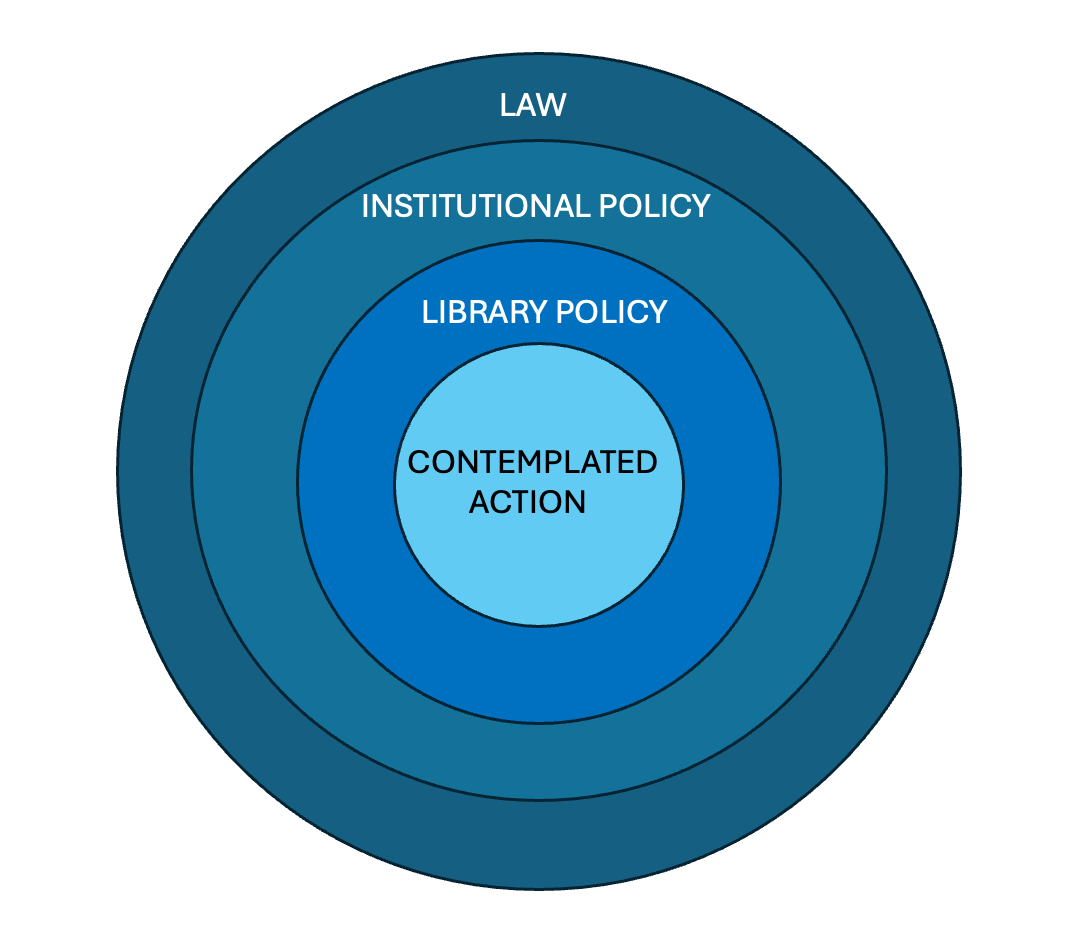
In Part 1 of this series, we briefly discussed a simple visual matrix designed to help us stay focused on the boundaries that define both what’s practically feasible and what’s allowed in our organizations.

In Part 2, we compared management and leadership positions in the library to the meniscus in the human knee – a cartilaginous structure that is designed to accommodate pressure from above and pressure from below, by keeping the leg in alignment.

In this third and final installment in the series, we’ll talk a little more about the importance of alignment in library leadership, and why maintaining it is such an essential part of the library leader’s job – and what alignment has to do with political capital, the overarching theme of this series of articles. 

A middle manager in a library needs to make sure that he keeps himself in alignment with his organization’s administration. Both understanding and advancing the library’s priorities is an essential part of any management assignment, whether the person in question is managing three student employees or a multidepartmental library division. If you chair a department, you both represent the library’s leadership to your team, and your team to the library’s leadership. And most of the time, this results in more-or-less constant (but minor) adjustments of perspective as you do your best to stand in the shoes of your staff when representing their needs and desires upward to administration and to do the same for the administration when representing their priorities and direction downward to your staff. The goal is to represent both parties, in both directions, accurately and in good faith.

But in any library, there will be moments when the administration insists on a direction or an initiative that the manager’s staff opposes, and when the discussion ends and the manager has to make a choice: undermine the administration’s decision, or convey to his staff that they are expected to carry out the initiative and will be held accountable for doing so.

In this moment, the manager has three choices:

1.        Undermine the library’s leadership

2.        Support the leadership and work to bring his staff along

3.        Step down as a manager

Items #2 and #3 represent ethical options. Item #1 does not.

Why? Because accepting a salary to work for an institution creates an obligation to help the institution pursue its priorities and strategic directions – and (except in very unusual organizations) the manager’s role is to contribute to the shaping of those priorities and directions, but not ultimately to determine them. That responsibility rests with the library’s administration – which, itself, has an ethical obligation to do so as carefully and wisely as possible, taking into account the needs and desires and input of management and staff. But it’s very rare that those final decisions make all management and staff equally happy, and someone will almost always oppose them. If, after such a decision is made, a manager genuinely cannot in good conscience work to move the organization in the direction set by its administrators, then declining to continue as a manager is a perfectly ethical course of action (though of course one would hope that it doesn’t have to come to that). Deciding to stay in place and undermine the administration’s decision is not an ethical course of action, because it goes against one’s express duties as a manager.

In other words: ultimately, for a manager, “alignment” means keeping one’s area of stewardship in alignment with the institution for which he works.

Obviously these same principles apply in the same way to library directors. They sit in a “meniscus” position between the library as a whole and the college or university administration to which they report; they advocate upward on behalf of their staff and their organization, and they advocate downward on behalf of the institutional administration. And ultimately, their ethical obligation is to keep the library aligned with the needs and strategic directions of the host institution. But this is important not only from an ethical standpoint, but also from a strategic one: the more clearly and consistently a library director demonstrates her alignment with institutional priorities, and shows that her library is working effectively to move the institution in the direction of those priorities, the more political capital she will amass on behalf of the library – political capital that can be spent later on behalf of the library’s needs and the needs of its staff.

I realize that some readers may be bristling a bit at my assertion that a leader’s job is to advance the larger institution’s priorities. What if the leader believes the institution’s priorities are misplaced, or improperly focused, or morally lacking? In that case, can it really be true that the leader’s only ethical obligation is to quit? I admit that this issue is maybe a bit more complex than I’ve indicated above. Let’s talk more about it in Thursday’s subscribers-only article: “What Is the Place of ‘Loyal Opposition’ in an Academic Organization?.” 

Takeaways and Action Items

  • An essential part of your job as a manager or leader is to advance (not undermine) the priorities of the organization for which you work.
  • Conspicuously aligning your department, division, or library with the strategic directions of your organizational host will add to your “bank account” of political capital.
  • Take a few moments to consider whether, in the past, you’ve found yourself in a position where you had to take a principled stand either against or in favor of an administrative direction. What principles guided you in taking that position? How did it work for you and your organization? In retrospect, is there anything you should have done differently?
Posted in Uncategorized | 1 Comment

Political Capital, Part 2: Leadership as a “Meniscus Position”

A former vice president at my current university had a wise and insightful analogy that she used when referring to leaders in management positions: she said that such roles can be characterized as “meniscus positions” because, like the meniscus in the knee, they are subject to both downward pressure from above and upward pressure from below – and, as with the physical meniscus, the key to avoiding pain and maintaining integrity is to stay aligned.

What are these pressures, and what does “alignment” mean in this context? Let’s look at the first question first.

Every library leader has probably experienced the frustration that can come from feeling whipsawed between an administration that wants one thing (and believes it’s the leader’s job to represent the administration’s position to staff) and a staff that wants something different (and believes it’s the leader’s job to advocate on behalf of staff to the administration). This dynamic can arise both within the library organization and between the library and the university leadership. When the administration’s position and the staff’s position are in conflict, what is the leader’s obligation? 

In Part 1 of this multi-part discussion, I put forward a hypothetical situation: a library department wants to start offering remote work options to its staff, and the library administration invests significant time and energy in discussing the possibility – but then realizes that remote work isn’t allowed as a matter of institutional policy, and therefore isn’t an option for library employees. 

 Now let’s imagine what happens next.

The word is sent back to the library department that their remote work policy proposal has been rejected, because it contravenes university policy. The administration expects that this will end the discussion – after all, the library doesn’t have power to change university policy and doesn’t have authority to enact internal policies that go against it. But instead of simply dropping the issue, the department chair comes back to the administration and argues that the library should be acting as a campus leader in this regard – should be, at the very least, advocating for a policy change on behalf of the library’s employees, and maybe even should be engaging in some judicious institutional civil disobedience by simply allowing remote work. In the latter scenario, either the library’s action would fly under the institution’s radar (in which case, the manager feels, no harm done) or it would be noticed and would bring the issue to a head and hopefully result in institutional change.

This puts the library leadership in the position of having to make a very important and potentially difficult decision regarding political capital. And in order to think about this dilemma effectively, I need to clarify what I mean by “political capital.”

Political capital is, admittedly, a bit hard to define precisely. I would characterize it as a complex of things: goodwill between people who have an organizational relationship; obligation that arises from past exchanges of resources; and expectations that shape interactions between people and organizational units. The ebb and flow of political capital within an organization is shaped significantly by dependencies that bind individuals and units together and can also create friction between them. 

💡
If you’re in a leadership position, you have only two choices: manage political capital in a conscious, strategic, and honest way, or accept the consequences of not managing it.

I also realize that the term “political capital” doesn’t sound good. It sounds cold and calculating and capitalist and cynical. I get that.

But here’s the thing: political capital is real, it is involved in every organizational interaction, and dealing with it is not optional. If you’re in a leadership position, you have only two choices: manage political capital in a conscious, strategic, and honest way, or accept the consequences of not managing it. 

In fact, managing political capital – both internally and externally – is one of the most fundamentally important roles of a library leader. A library director, for example, needs to think about it this way: virtually every interaction the director has with campus administration either banks political capital or draws on an existing fund of political capital. Examples of actions that will tend to add to the library’s fund of political capital might include:

  • Undertaking (and successfully completing) a project on behalf of university administration
  • Providing a service that makes a major university donor happy
  • Allowing an important campus program or service to take up residence in the library, whether temporarily or permanently
  • Publicly expressing support for a university priority or initiative

Actions that tend to draw down the library’s fund of political capital might include:

  • Asking for a budget increase
  • Saying “no” to any request from campus administration
  • Proposing a change to campus policy
  • Publicly objecting to official institutional positions or contradicting institutional statements

Now, a couple of things are very important to note here.

First, asking for virtually anything results in a drawdown of political capital, even if the request is unsuccessful. Simply asking for money, or proposing a change to campus policy, costs political capital.

Second, the library leader’s job is not to avoid drawing down political capital. The library leader’s job is to make those withdrawals wisely and strategically. Just because a course of action will involve an expenditure of political capital does not mean it’s an unwise course of action.

So let’s return to our scenario with the remote work proposal.

The director is now facing pressure from below to propose a policy change to the administration above; the existing policy creates pressure from above against such a change – and the director has to decide whether to resist the pressure from below (“Sorry, I’m not going to propose this policy change to administration”) or resist the pressure from above by pushing upward against it on behalf of the library staff.

What makes the calculus complex in this case is that the library director has a “bank account” of political capital not only with the university administration, but also with the library staff. To push for an institutional policy change (whether successfully or not) would draw down the balance of the former, while banking political capital with the latter – and vice versa. 

A selfish and ineffective leader will consider these funds of political capital in primarily personal terms: “Will it make my life easier if I bank political capital with the administration, or with my staff?”. A wiser leader will think in terms of the needs of the organization she serves and the staff she manages and will marshal the library’s political capital accordingly. Depending on circumstances, these considerations may lead to different strategic approaches. For example, the director may:

  • calculate that the library’s existing fund of political capital is very deep at the moment, and that raising this issue on behalf of the staff is more likely to create a net benefit for both the library and the university than declining to do so;
  • look back on recent months and see that there have been difficult moments that drew down the fund of institutional political capital, and respond to the internal manager that while this may be an issue worth raising in the future, it’s not a good idea now;
  • look back on recent months and see that there have been difficult moments that drew down the fund of political capital with her staff, and decide that this is a particularly good moment to rebuild morale by advocating upwards on their behalf.

Of course, the director might also determine that regardless of what could possibly be done at the institutional level, remote work is just not a good idea in the context of the library organization, and respond accordingly to the manager. This response would result in an expenditure of internal political capital – but it may also be the right thing to do.

Because again: the library leader’s job is not to avoid any expense of political capital – it’s to make sure that political capital is both banked and expended wisely and strategically. 

Next week, in Part 3 of this series, we’ll dive a bit deeper into the issue of “alignment.”

Takeaways and Action Items

  • If you’re in a leadership position, you have only two choices: manage political capital in a conscious, strategic, and honest way, or accept the consequences of not managing it.
  • Every action you take as a library leader either banks or draws down your funds of political capital with both your host institution and the employees of library in which you lead.
  • Take a few moments and consider what political capital looks like in your particular situation. Where is your “bank account” of political capital the strongest, and where might it need to be deepened? What can you do to deepen it where necessary – and does its depth in other areas offer you strategic options that you haven’t considered?
Posted in Uncategorized | Leave a comment

Political Capital, Part 1: Big Circles and Little Circles

As library leaders, we’re constantly faced with decisions that require an understanding of the boundaries that separate what’s possible from what isn’t – that define both what’s feasible and what’s allowed. (There’s merit, of course, in thinking about when and how one should try to transgress both of those boundaries, but we’ll address that idea in a later post.) 

Here’s one of the most useful mental constructs I’ve found for thinking about the particular boundaries that define what is and isn’t allowed.

My staff have all gotten very used to – well, okay, maybe a little tired of – hearing me invoke the idea of “big circles and little circles.” In this model, concentric circles signify the scope of possible action. Understanding the parameters of these circles helps us avoid wasting time and energy debating options that aren’t actually on the table.

The construct is pretty simple, and for most of us it represents a principle that is intuitively obvious. Here’s how it looks:

What’s represented in this diagram is the simple fact that an institution’s practices are constrained by the law; a library’s practices are constrained by policies of the host institution; and individual library employees and organizational units are constrained by library policy. Each circle can move around within the next circle in the hierarchy, but doesn’t have authority to move outside the bounds of that next circle. In other words, while the library has significant room to make and adjust its own policies, it doesn’t have the power to enact policies that go against university policy – and doing so runs the risk of sanction.

So, for example:

Suppose a library department wants to extend a remote work option to its employees. The work of the department is such that doing it from home is reasonably practical, and there are lots of ways in which offering remote work would make life easier for the employees. The department head, finding that there is not currently a library policy regarding remote work, forwards a proposal to the library administration for consideration. 

The library administration considers the pros and cons of the remote work proposal. The leadership group can see both significant upsides and real potential downsides to the proposal. Debate over letting the department offer remote work unfolds over the course of two meetings and several days of group email exchanges – issues of workplace equity, procedural efficiency, and patron service are all discussed, as are considerations of employee morale and the complex impacts that the department’s proposal could have in all of those areas. The conversation becomes not only time-consuming but also a bit heated. Feelings are strong on both the pro and con sides, and because the issues are complex, it becomes clear that there isn’t going to be a way forward that makes everyone happy. 

Then one member of the administration puts her hand up and says “Wait. Is there a university policy regarding remote work?”. The group assigns someone to search the institutional policy library – and this person learns that, in fact, the university does not permit remote work except in unusual circumstances, which are tightly defined and do not include the circumstances at play in the library. With this, the group realizes that it could have spent its time and energy over the past few days on other issues rather than arguing the merits of a proposal that was outside the boundaries of the library’s authority to enact.

The principles at play here are, I suspect, pretty obvious to all readers: recognizing that libraries are subject to the policies of their host institutions isn’t exactly a deep insight into organizational dynamics. And yet I also suspect that any reader who has had experience as a manager or administrator is also thinking back to all the times that he or she had to discuss this very principle with one or more employees who wanted the library to enact a practice that contravened institutional policy, and who felt the library should “lead out” in this regard – or, at least, that the library leadership should advocate on behalf of their employees for a policy change to accommodate the proposed practice. And, of course, those employees may have been right.

To consider the more complicated dynamics of this situation, we have to think about the library leadership’s campus role in what we might call a “meniscus function.” And this brings us firmly into the realm of political capital, and its management.

We’ll dive more deeply into this topic in Thursday’s subscribers-only post.

Posted in Uncategorized | Leave a comment

Leadership 101: It’s not about you.

I realize the title of this inaugural article might come across as a bit… I don’t know… vinegary? But I hope that by its end, the vibe you get will be more encouraging than that – so please read on.

I’m convinced that one of the most fundamental lessons a leader can learn – one that should be learned as early as possible, ideally prior to taking on one’s first leadership position – is that a big part of a leader’s job is to redirect the limelight away from him- or herself and towards the people s/he leads.

This is difficult, I admit. Let’s just acknowledge something right up front: the people most likely advance through the leadership ranks may not always be those who naturally shy away from the spotlight, and who hate being the center of attention. But even if you don’t feel a constant craving for attention and affirmation, there’s a good chance that you still don’t really mind those things – and I think it’s safe to say that giving credit to others and shifting positive attention to other members of one’s team may not come completely naturally to anyone.

Nothing is quite as demoralizing to an organization as a leader who acts as if the organization is an extension of his own ego. Don’t be that boss.

But here’s the thing: nothing is quite as demoralizing to an organization as a leader who acts as if the organization is an extension of his own ego. Having a boss who constantly needs affirmation is exhausting. Having a boss who hogs the spotlight is embarrassing. Having a boss who takes credit for the accomplishments of others is infuriating. Don’t be that boss.

Now, it’s easy to say that leadership is “not about you.” But what does that mean in practice? If you have a boss who really understands that it’s “not about her,” what does her leadership look like?

I was blessed to report for seven years to a library dean who exemplified this understanding, and who modeled its application beautifully. Here are several important things she did and didn’t do:

  • She never bragged about her own accomplishments. I can’t think of a single time that she drew attention to her own achievements or took credit for the library’s successes – despite the fact that her achievements were significant and the library’s successes were many, and despite the fact that her leadership was a major contributor to those successes. 
  • She never missed an opportunity to brag about other people’s accomplishments. Whenever someone noted the library’s outstanding physical facilities, collections, services, or reputation, she found ways to point out how the work and talents of others in the organization had made those things outstanding. And she actively sought out opportunities to praise members of her team – in specific ways that showed both her awareness and her understanding of their work – to people outside the library.
  • She gave her team opportunities to share their accomplishments with each other. In monthly all-staff meetings, the last agenda item was always an open invitation for people to tell her, publicly, about the cool things they were working on or unusual achievements in their units. She would walk out into the audience to stand close by those who were talking, and expressed her appreciation sincerely. There was a double genius to this approach: for one thing, we all got to see her express appreciation to our colleagues in a public forum, which is always healthy. For another, this practice helped create a culture of openness about accomplishment within the organization, which was valuable in itself – and, also importantly, it raised our awareness of the great things that others in the library were accomplishing.

In connection with that last bullet point, there’s an insight from the realm of child development that I think has particular relevance to leadership: praising your child for something specific can be very helpful and positive, but he’s more likely to believe your praise when he overhears you praising him to someone else. Why? In part, because your child knows that you have a vested interest in making him feel good about himself. (He may even have noticed that you tend to exaggerate his virtues a little bit, especially when talking to him.) However, your child will generally assume that you tell the truth to other adults. If he hears you telling another adult that he’s a talented artist or really helpful with his siblings, he’s more likely to take it as a real and meaningful assessment of his qualities than if you just tell him those things directly.

In an organizational context, that principle works too: we take praise for our work more seriously when we overhear it being communicated to others. So finding opportunities to praise our team members in the presence of other team members can be especially powerful.

Now, I don’t claim for a moment to be as good at these things as my former boss is. But during the years I reported to her, I gained a deep appreciation for the importance of directing the spotlight of attention and appreciation away from myself and towards those I lead. I’m always trying to do that more consistently, and I’m always looking for better ways to do it.

Takeaways and Action Items

1.        The next time someone praises your library, respond by telling them about someone in the library other than you who does things to make it praiseworthy.

2.        The more you draw attention to the good work of others, the more it will reflect well on you as a leader. 

3.        Look for programmatic and structural ways to draw public attention to the work of under-recognized people in your library. 

  1. Praise your people to others – sometimes in your people’s presence, and sometimes behind their backs.
Posted in Uncategorized | Leave a comment

Welcome to Vision & Balance

This is a twice-weekly newsletter devoted to management and leadership in academic libraries, drawing on things I’ve learned over the course of a 30-year career – sometimes by making mistakes, sometimes by doing things that worked really well, and always by carefully watching the examples (both good and bad) of other managers and leaders. If you’re a supervisor, a manager, or an administrator in an academic library, Vision & Balance offers you the chance to learn things the easy way that I’ve learned the hard way.

The newsletter’s title and subtitle incorporate four important concepts:

Vision. To lead, you need to know where you want your organization to go – whether it’s a small work unit of two or three people, a department, a division, or a whole library. Determining your desired direction and figuring out how to move accordingly are essential elements of leadership. So are understanding the unique possibilities and limitations of doing so in the context of an academic library – which leads to the need for balance

Balance. Supervision, management, and leadership require difficult choices about how resources will be allocated and how competing needs will be negotiated. Maintaining a productive and appropriate balance between competing needs in a context of limited resources is one of the most fundamental duties of library leadership, at any organizational level.

Leading. In the context of this newsletter, “leading” refers to the work of both leadership and management: managing in the library entails leading and leading in the library entails management. While we’ll observe distinctions between the work of higher-level leadership and that of more operational management in the course of our discussions here, the words “leadership” and “leading” will often be used as umbrella terms for leadership, management, and supervision.

Academic libraries. This newsletter’s author, Rick Anderson, has over 30 years’ experience working in and around academic libraries, as a service provider, a manager, an administrator, and a dean or director. While Vision & Balance will regularly address issues common to many different kinds of libraries, the focus will be on his more specific area of expertise: issues of particular relevance to academic libraries.

Vision & Balance is published twice weekly: a briefer entry on Tuesdays (freely available to the public) and a longer entry on Thursdays (for paying subscribers).

Posted in Uncategorized | Leave a comment